A ShortEx Program
The Balkan Lab
Field-Based Learning
in Bosnia and Herzegovina
An academically rigorous field program where students explore democracy, governance, identity, peacebuilding, and international engagement through direct engagement with institutions, experts, communities, and diverse perspectives.
Designed for universities · Customizable academic programs · Bosnia and Herzegovina
Bosnia and Herzegovina is not simply a destination. It is a living classroom.
Bosnia and Herzegovina brings together some of the defining questions of contemporary politics: democratic governance, constitutional design, identity, peacebuilding, international engagement, collective memory, accountability, and social cohesion.
Rather than studying these concepts only through lectures and textbooks, students encounter them in institutions, public spaces, communities, and conversations with the people who work within these realities every day.
The value of studying Bosnia is not only understanding Bosnia. It is learning new ways to think about complex societies.
The Learning Model
Learning happens when theory meets reality.
LEARN
Academic seminars establish the historical, political and conceptual frameworks students need to interpret what they encounter in the field.
ENGAGE
Students meet institutions, policymakers, academics, journalists, civil society organizations, international actors, religious communities and practitioners representing different perspectives.
REFLECT
Structured discussion and guided reflection help students connect individual experiences, challenge assumptions and transform observation into academic understanding.
The program is not a sequence of isolated visits. Each experience builds upon the previous one, allowing students to gradually construct their own informed understanding.
The Program
A Sample Learning Journey
The following ten-day journey illustrates how The Balkan Lab can transform Bosnia and Herzegovina into a connected academic experience. Each day is organized around a central question rather than a list of tourist activities.
- Day 01
Arrival & Orientation
Students are introduced to the learning philosophy and encouraged to approach the program with curiosity, observation and critical thinking rather than predetermined conclusions.
- Day 02
Why Bosnia Works the Way It Does Today
Conflict, memory, the Dayton Peace Agreement and the historical foundations necessary to understand contemporary Bosnia and Herzegovina.
- Day 03
How Does Bosnia Govern a Deeply Divided Society?
Institutions, constitutional design, power-sharing and the realities of decision-making in a complex multi-level political system.
- Day 04
Why Do International Actors Still Matter?
The European Union, Office of the High Representative, NATO, United Nations and the continuing role of international engagement in post-conflict governance.
- Day 05
How Does Republika Srpska Understand Bosnia and Herzegovina?
Banja Luka provides a different institutional and political perspective on Bosnia and Herzegovina, entity-level governance and the relationship between different levels of government.
- Day 06
Can Democracy Function Without Accountability?
Civil society, investigative journalism, corruption, transparency, media freedom and democratic oversight.
- Day 07
How Do Identity and Religion Shape Politics?
Political culture, identity, interfaith engagement, collective memory and the relationship between religion, nation-building and contemporary political life.
- Day 08
Can One City Tell the Story of Bosnia?
Mostar becomes a living case study connecting governance, identity, education, reconstruction, urban space and post-conflict society.
- Day 09
From Field Experience to Academic Inquiry
Students synthesize their experiences, identify unresolved questions and develop ideas that can become the foundation for further academic research.
- Day 10
Departure
Students leave Bosnia and Herzegovina with deeper understanding, comparative insight and—most importantly—better questions.
Explore the Complete Academic Prospectus
Download ProspectusFour Learning Lenses
Bosnia and Herzegovina is not studied through a single discipline or narrative. Students explore the country through four interconnected lenses.
War, Memory & Reconciliation
Conflict, transitional justice, memorialization, reconciliation, competing narratives and collective memory.
Governance, Democracy & Institutions
Constitutional design, power-sharing, elections, policymaking, public administration, accountability and civic participation.
International Engagement
Diplomacy, peace implementation, European integration, development cooperation and the role of international organizations.
Identity, Society & Religion
Identity, religion, ethnicity, education, media, culture, diversity, coexistence and social cohesion.
These lenses are not studied independently.
Students explore how history shapes institutions, how institutions influence identity, and how domestic politics interacts with international engagement.
Our Promise
We will not tell students what to think.
We will not offer a single narrative.
We will not simplify complexity.
We will create opportunities to question assumptions.
We will connect classrooms with institutions.
We will connect theory with practice.
We will encourage dialogue over certainty.
We will leave students with better questions than the ones they arrived with.
Why ShortEx
Built by people who work in the field.
ShortEx programs are developed by political scientists, researchers, educators and practitioners with professional experience across democratic governance, public policy, elections, civic engagement and peacebuilding in Bosnia and Herzegovina.
Our work gives students access not only to places, but to the institutions, practitioners and conversations that shape contemporary Bosnia and Herzegovina.
Every institution we visit, every guest speaker we invite and every discussion we facilitate is selected with a clear educational purpose. Our role is not simply to organize activities, but to curate an intellectually rigorous learning experience that connects theory with practice.
Our Story
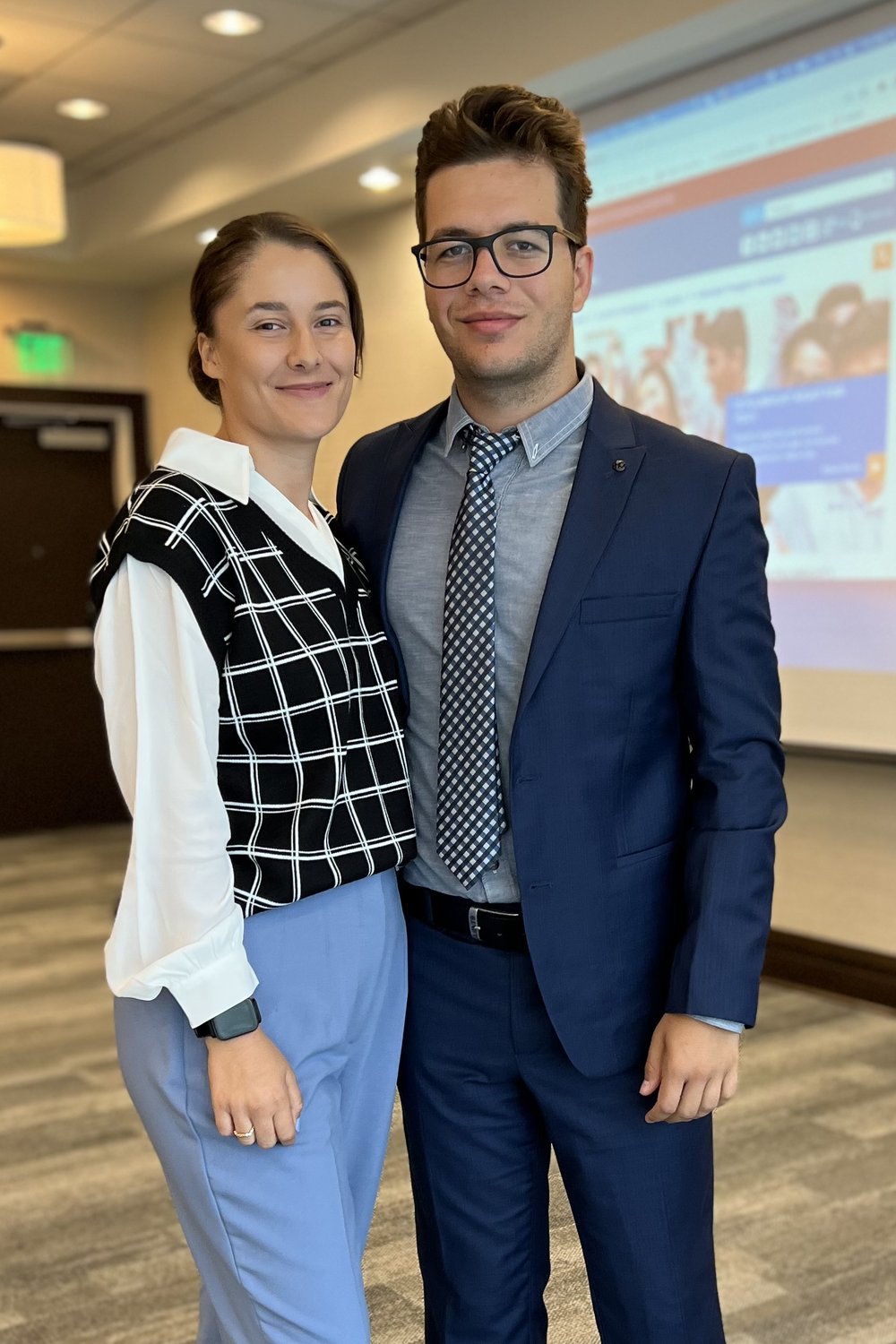
We met as Political Science students at the University of Banja Luka, sharing an interest in politics, international relations, democracy and the complicated realities of the Western Balkans. During those years, we both had opportunities to experience international academic and leadership programs firsthand — from Erasmus+ in Europe and the BOLD Academic Fellowship in the United States to peacebuilding and youth programs in Japan and across the region.
Those experiences shaped the way we understood education. The most valuable moments rarely happened only in classrooms. They came from conversations with practitioners, exposure to different perspectives, visits to institutions, and the opportunity to understand how political systems actually work on the ground.
Over time, we moved from participants to practitioners.
Our professional paths have taken us through civil society, international organizations, election monitoring, public advocacy, political and policy research, youth advisory bodies and consulting. Sara has managed national and regional programs, worked with the UN system and coordinated initiatives bringing together institutions, civil society and young people. Srđan has worked extensively on elections and democratic governance, trained election observers, contributed to advocacy for electoral reform and provided political and institutional analysis for international clients.
Through our work, we have engaged with government officials, diplomats, international organizations, journalists, academics, civil society leaders and communities throughout Bosnia and Herzegovina. We later began using that experience as trainers, facilitators and lecturers for both local and international audiences.
Along the way, we also became husband and wife and parents of two children — while continuing to build careers rooted in the region we study, question and care deeply about.
What people say about our work
The Balkan Lab is built on years of experience in study visits, workshops, facilitation and international programs. These reflections come from people who have previously participated in or collaborated on related work with members of our team.
The Balkan Lab offers insights into the complexity of a region that has been a crossroads of history for millennia. Srđan and Sara are just the right people to facilitate your learning journey. They were my top-performing students in a program for young leaders of the Balkans that I co-led. I smile to remember when we all gathered in Times Square in New York for Srđan to get down on one knee and propose to Sara. Later, they skillfully organised my trip to Banja Luka, co-facilitated a workshop with me, arranged visits to a leading NGO, historical sites, and interesting people. Please hire The Balkan Lab if what you want is a deeper, life-changing experience in a beautiful, post-conflict, fascinating part of the world.
Patrick McNamara, Ph.D.
Executive Director, United States–Sri Lanka Fulbright Commission
In August 2024, Srđan supported a study visit to Banja Luka organized for a group of early-career peacebuilding researchers from Azerbaijan. Through his lecture and guided walk, he connected the city’s public spaces with the wider political and historical realities of post-war Bosnia and Herzegovina. He spoke openly while resisting easy narratives or oversimplification, something our group particularly appreciated given their own experience of studying conflict and peacebuilding. Srđan was also an attentive and dependable local partner, helping us manage the practical details and making the visit both intellectually valuable and memorable.
Shujaat Ahmadzada
Independent researcher from Azerbaijan
I came from Israel to BiH for an event together with students from across Europe. As someone who had never been to BiH before, I arrived knowing relatively little about the country, its politics, society, and the different perspectives within it. On a personal level, Sara and Srđan were among the first people I met, and from our very first conversation, we immediately had a really lovely and genuine exchange. I especially appreciated how naturally and openly we could talk, share our different perspectives, ask questions, and learn from each other with so much curiosity and mutual respect. Their session had exactly the same atmosphere: informative, interactive, and open-minded, while helping us better understand the complexity of politics and society in Bosnia and Herzegovina on the ground. Thanks to Sara and Srđan, I left Bosnia with much more knowledge, but also with wonderful memories and a very personal and positive connection to the country and its people.
Emilia Taran
International Relations student from Israel
What stayed with me most was that none of the activities ever felt like “just another lecture.” There was always something that challenged me to think more deeply, reconsider my own assumptions, or hear a perspective I had not considered before.
The activities were very well organized, but at the same time open and engaging enough for participants to genuinely take part in the conversation. I always left with new knowledge, but also with new questions and a broader understanding of the topics we discussed.
For me, that was what made the experience so valuable: it was not simply about receiving information, but about thinking critically, exchanging perspectives, developing my own views, and learning from the people around me.
Stevanija Ciganović
International Relations student, University of Ljubljana
Your course. Our field.
Every Balkan Lab program is developed in collaboration with the partner institution.
The academic focus, speakers, institutional visits, duration and learning objectives can be adapted to complement an existing course, faculty research interest or disciplinary perspective while maintaining the educational philosophy that defines the program.
Typical duration
7–10 days
Format
Faculty-led / academic cohort
Location
Bosnia and Herzegovina
Group size
Custom
Bring your classroom to Bosnia and Herzegovina.
Tell us what your students are studying. We’ll help you explore how it can be experienced in the field.